Mathematics of Trading: Modeling Randomness
Random Walks → Brownian Motion → Geometric Brownian Motion → Monte Carlo Simulation
How Markets Generate Noise, How We Model It, and Why Every Trading Strategy Exists Inside a Cloud of Possible Futures
Financial markets look noisy and chaotic:
- prices wiggle unpredictably
- shocks appear out of nowhere
- paths diverge dramatically
- volatility comes in clusters
- trends emerge and collapse
To understand:
- edge
- variance
- drawdowns
- ruin
- tail events
- strategy testing
- stress scenarios
we must understand randomness.
This post shows:
- How randomness is modeled mathematically
- How prices evolve in uncertain environments
- Why Brownian motion is the backbone of modern finance
- Why GBM is the standard model for price dynamics
- Why Monte Carlo simulation is essential for real-world risk analysis
This is the most mathematically important post so far.
Randomness: The Foundation of Market Behavior
Markets look random even when they aren’t purely random.
They are driven by complex forces:
- order flow
- liquidity pressure
- news shocks
- behavioral cascades
- algorithmic interactions
Even so, randomness provides a tractable mathematical framework that captures essential features of market movement.
We begin with the simplest model.
Random Walks: The First Market Model
A random walk evolves by adding random increments:
Where:
A random walk captures:
- short-term unpredictability
- long-term variance growth
- path dependence
- divergence between sample paths
Variance grows linearly
Meaning:
- uncertainty increases with time
- small randomness accumulates into large randomness
Distribution approaches normal
even if the step distribution is simple.
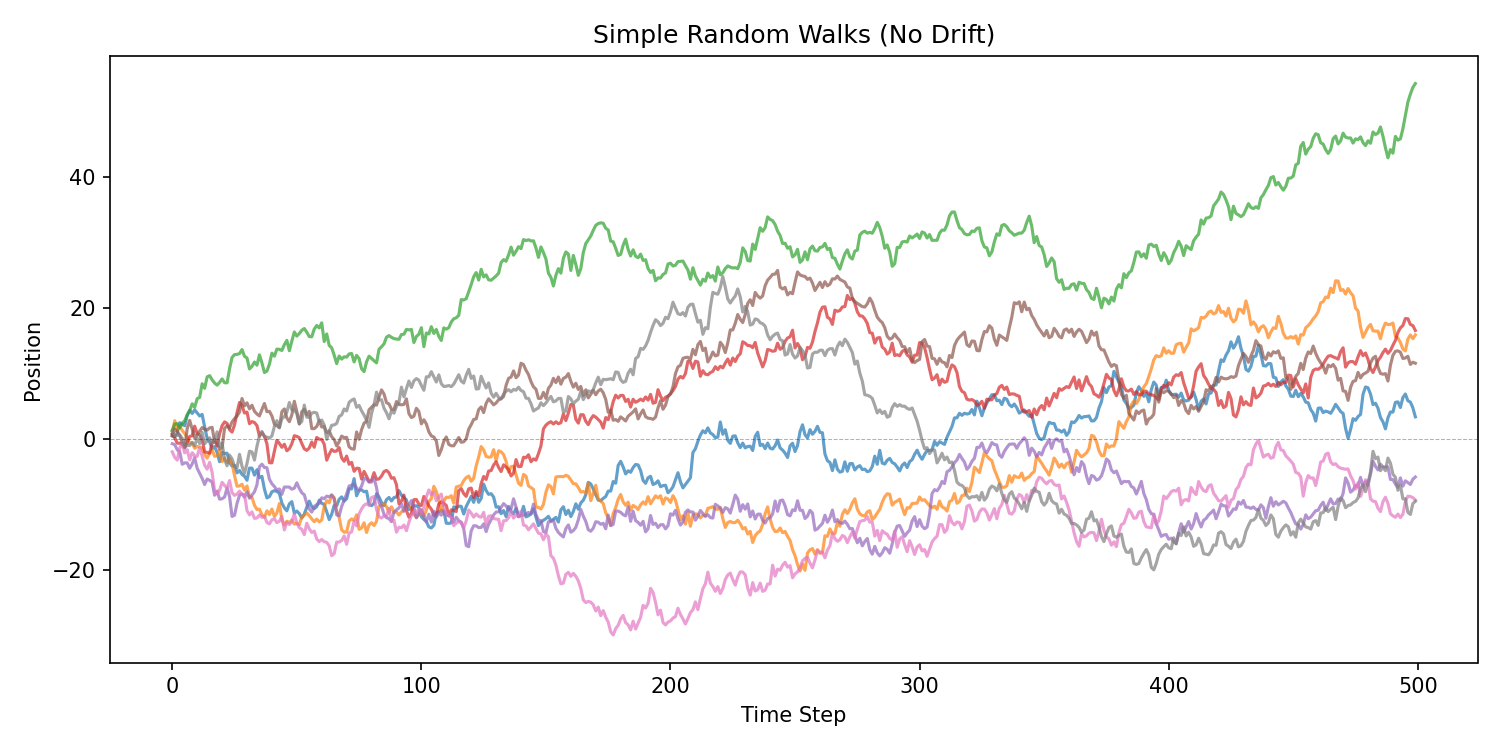
Random walks already look surprisingly like real markets.
But prices cannot go negative — that requires refinement.
Random Walks With Drift
Markets exhibit long-term upward drift (risk premium).
We add a deterministic trend:
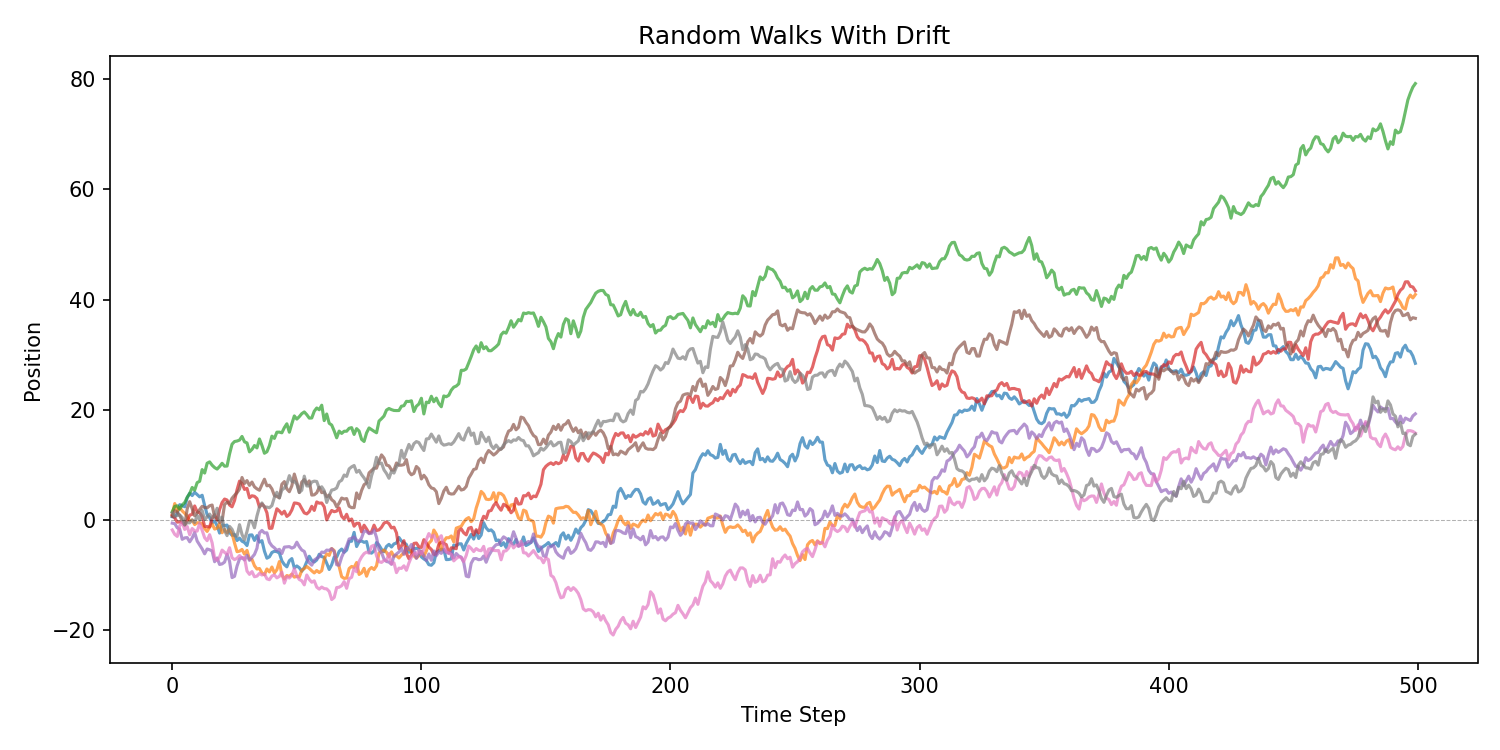
Now the process trends upward on average, but remains unpredictable path-by-path.
Still, this model is additive — markets are multiplicative.
Log Returns: Fixing the “Negative Price” Problem
Markets move in percentages, not points.
- A 1% move at 100 = +1
- A 1% move at 200 = +2
So price changes scale with price.
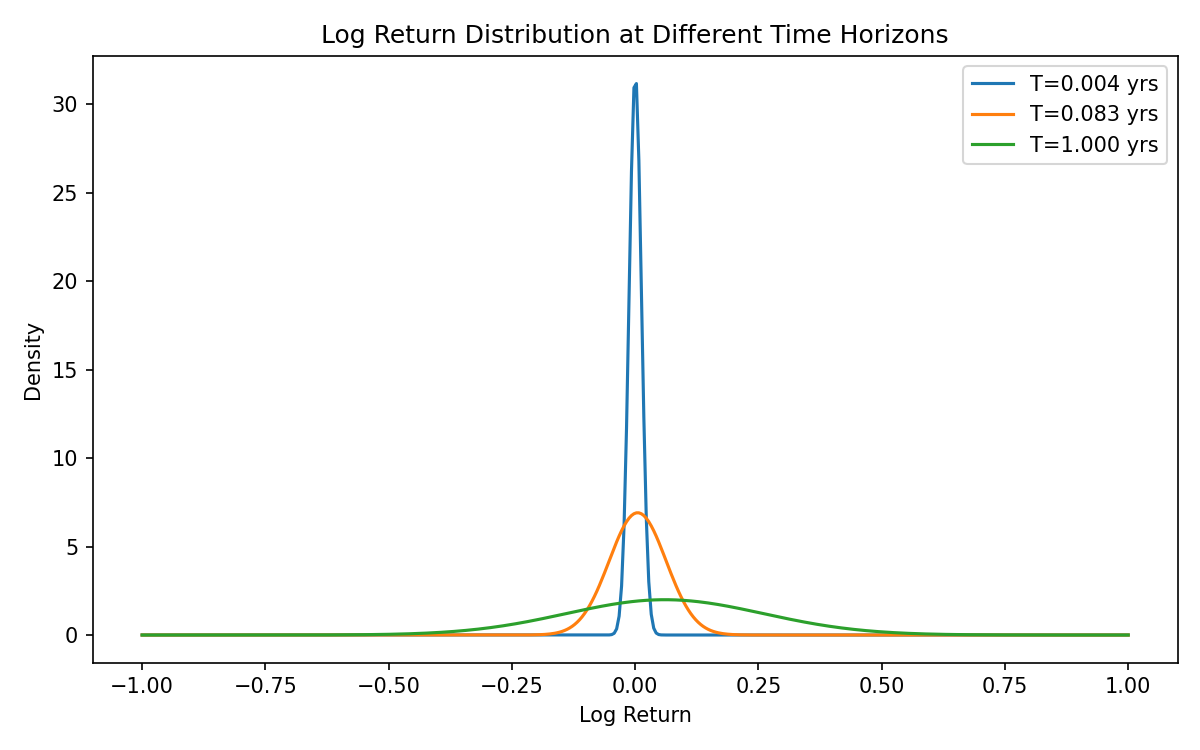
We model log returns:
Log returns are:
- additive
- stable
- symmetric-ish
- always yield positive prices
If log prices follow a random walk:
then prices are always positive.
Brownian Motion: Continuous-Time Randomness
Discrete random walks converge to a continuous-time stochastic process:
Brownian motion (also called Wiener process).
Properties
- ( W(0) = 0 )
- Independent increments
- Normal increments
- Variance grows linearly:
- Continuous but nowhere differentiable (capturing jagged market behavior)
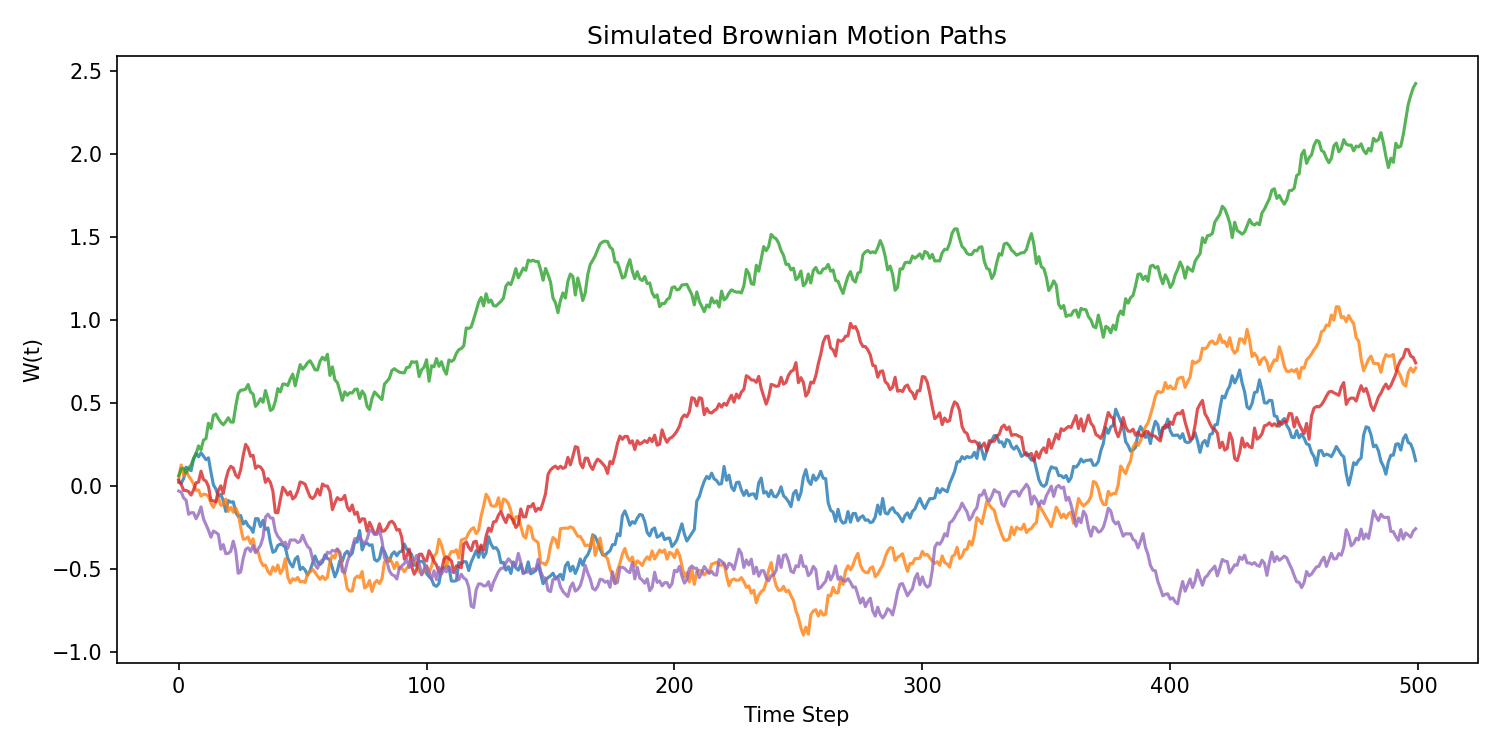
Brownian motion is the mathematical engine of nearly all classical financial modeling.
Brownian Motion With Drift
Add deterministic growth:
Interpretation:
- : predictable drift
- : stochastic noise
This structure maps directly to short-term unpredictability + long-term trend.
Geometric Brownian Motion (GBM): The Standard Model for Asset Prices
Raw Brownian motion can go negative — unacceptable for prices.
GBM fixes this:
This implies:
Consequences
- prices stay positive
- log returns are normal
- volatility scales as
- paths diverge exponentially
- uncertainty grows multiplicatively
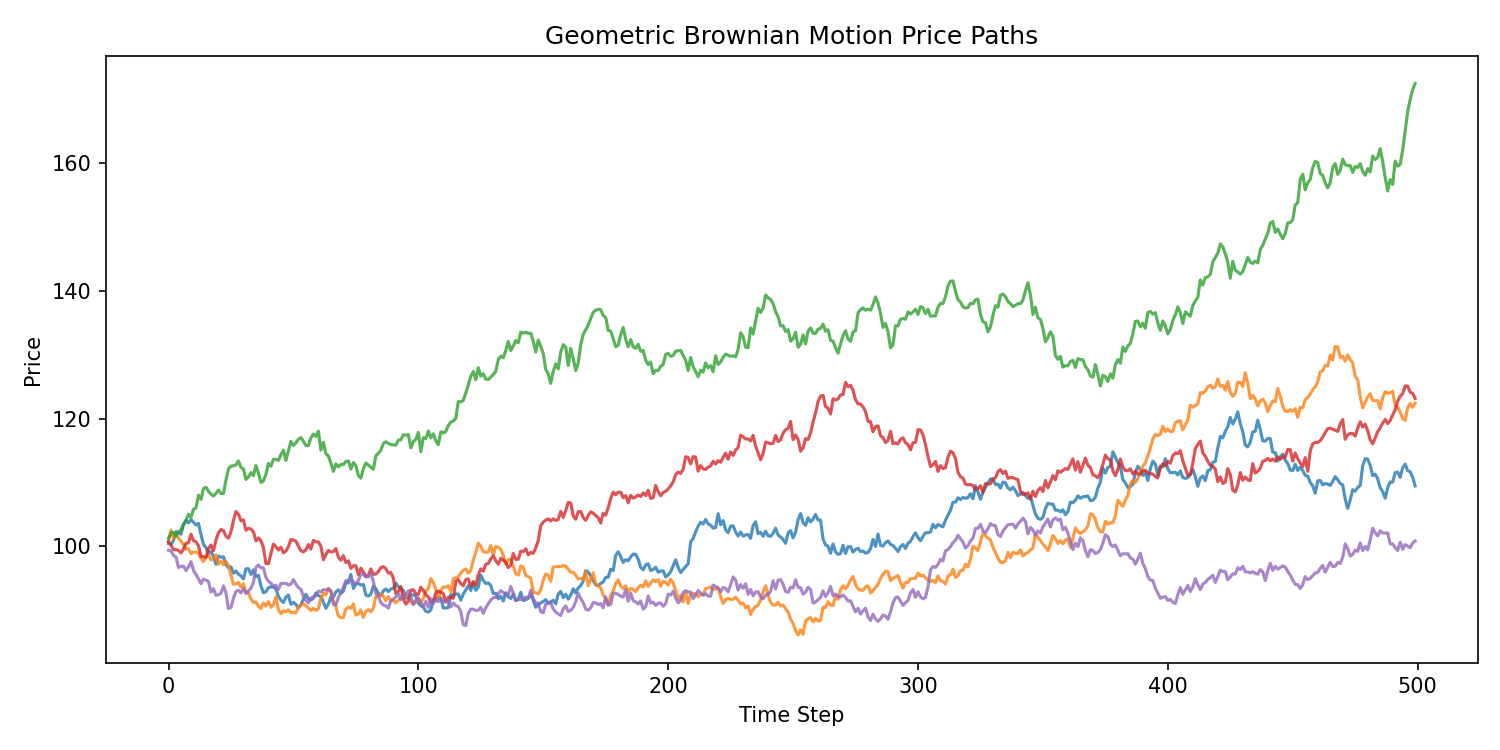
GBM is used in:
- Black–Scholes
- VaR models
- forecasting tools
- Monte Carlo simulators
- quantitative trading research
It is not perfect — but it is the essential baseline.
GBM vs Real Markets: Where the Model Breaks
GBM assumes:
- constant volatility
- no jumps
- normal returns
- no clustering
- no skewness
- no fat tails
Real markets have:
- volatility clustering
- fat tails
- negative skew
- jumps
- regime shifts
- autocorrelation in volatility
GBM is the starting point. Monte Carlo is how we test deviations from it.
Monte Carlo Simulation: Modeling Thousands of Futures
A single historical backtest gives one path.
Monte Carlo simulation gives thousands.
It answers:
- How wide is the distribution of possible outcomes?
- How deep can drawdowns get?
- How frequently does ruin occur?
- How much tail risk exists?
- How volatile is performance across paths?
Monte Carlo = risk in full resolution.
Monte Carlo Example Set 1 — Gambling Games
Example A: Coin Flip Wealth Paths
Game:
- +1 for heads
- –1 for tails
- 200 flips
Simulate 10 paths.
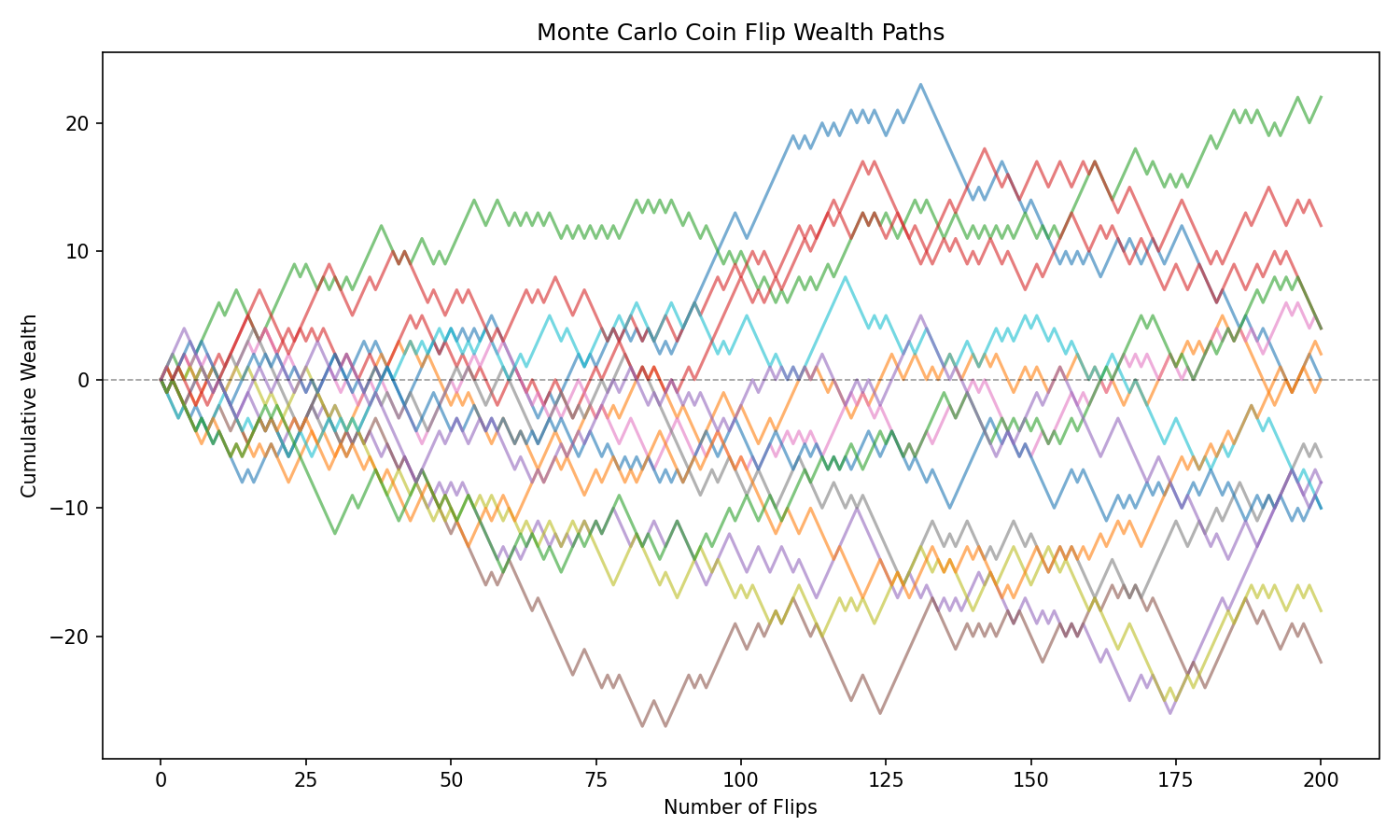
Observations:
- same rules, wildly different outcomes
- variance compounds
- prediction is impossible
Example B: Gambler’s Ruin
Start with 1 per flip Goal: reach 0
Monte Carlo estimates:
- probability of ruin
- distribution of time to ruin
- expected play length
- impact of unfavorable odds
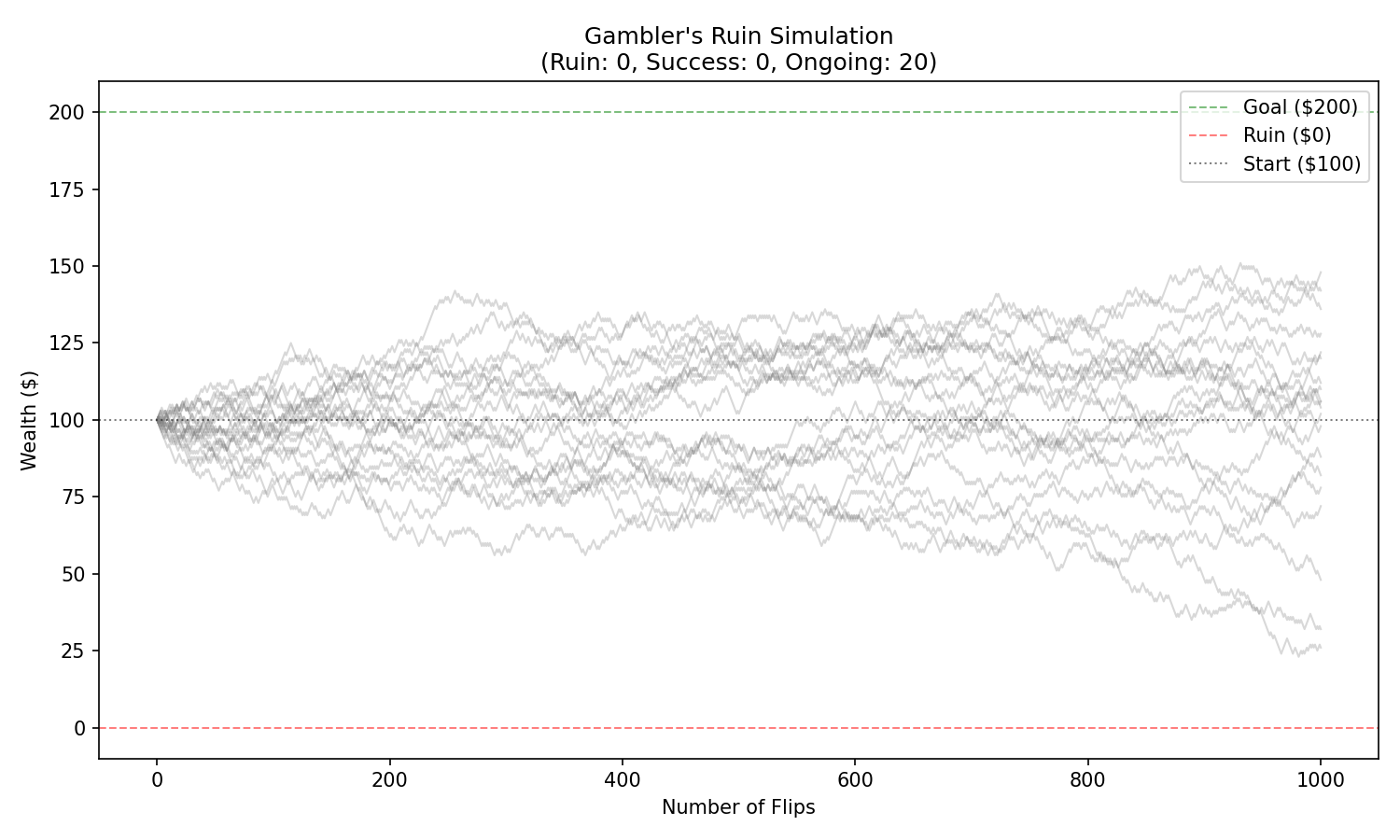
This problem is the ancestor of modern risk-of-ruin theory.
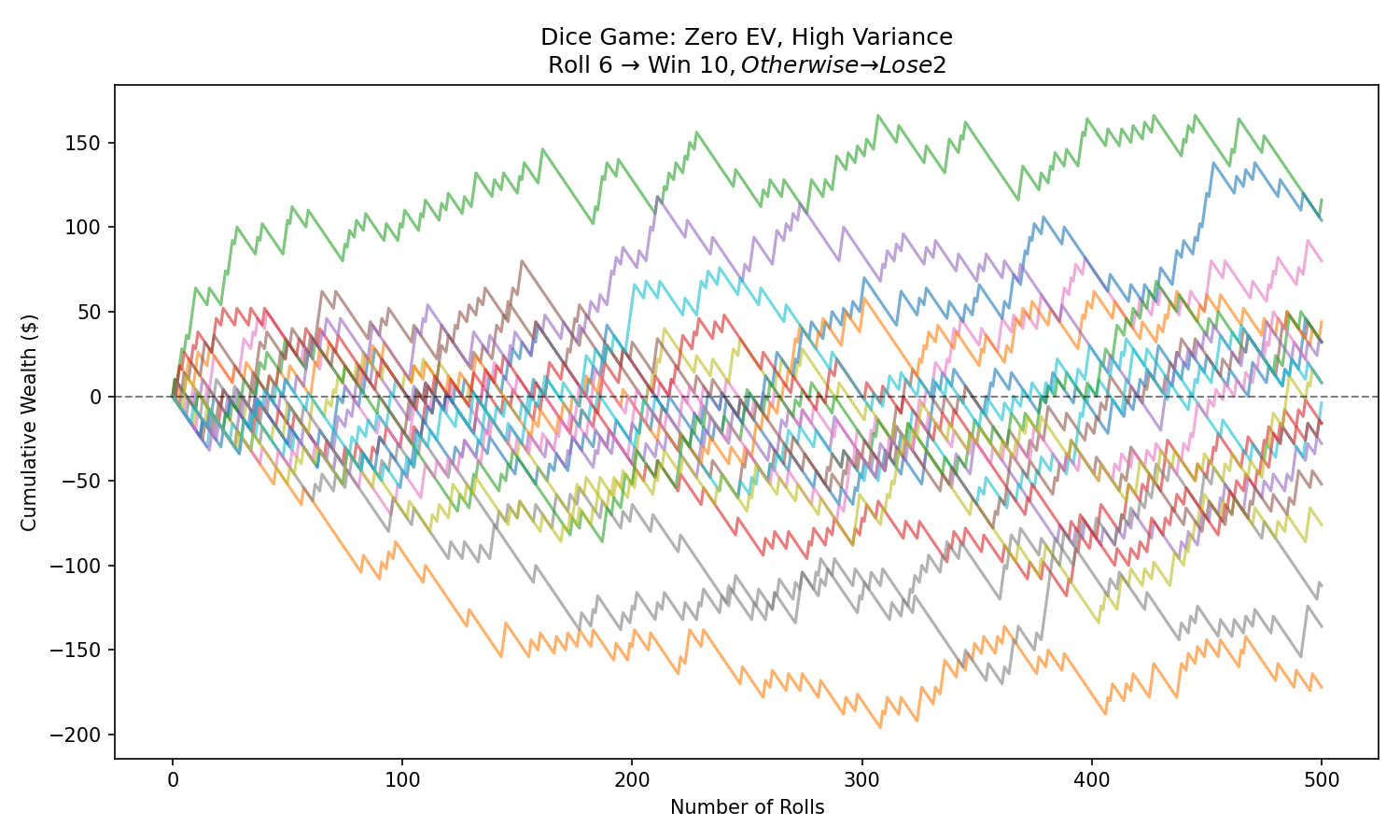
Example C: Dice Game EV Simulation
Game:
- roll a die
- 6 → win $10
- otherwise → lose $2
Analytical EV = 0
But Monte Carlo shows:
- long drawdowns
- variance around 0
- risk of ruin despite fair odds
11. Monte Carlo Example Set 2 — Markets
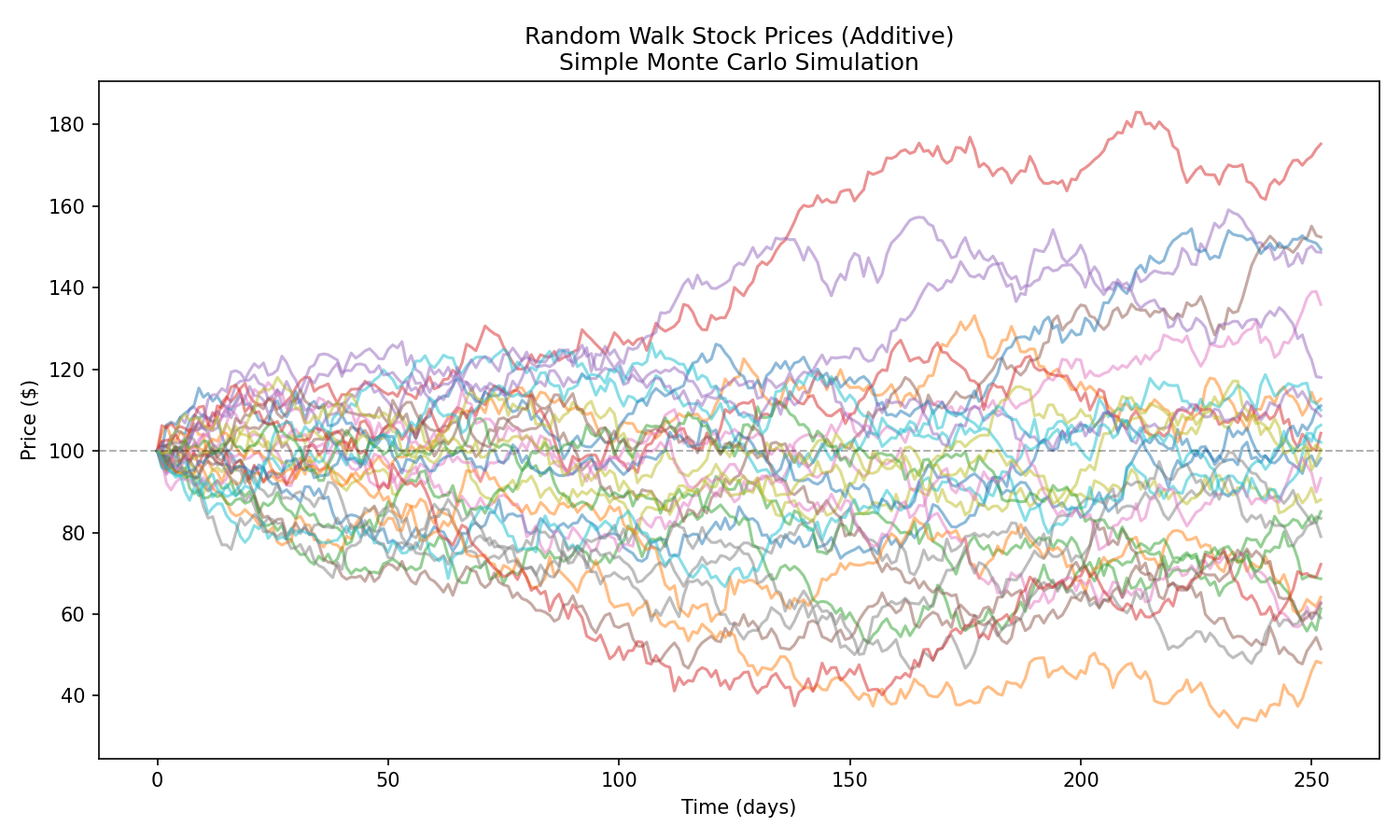
A. Random Walk Stock Prices
The simplest price simulation.
Reveals:
- range of possible trajectories
- divergence of sample paths
- exploding uncertainty over time
B. GBM Price Simulations
For GBM:
with .
Simulate 50 paths:
- drift nudges upward
- volatility broadens the cone
- uncertainty grows exponentially
- extreme paths appear naturally
C. Final Price Distributions
Simulate 10,000 paths.
Ending prices follow a log-normal distribution:
- median < mean (volatility drag)
- fat right tail
- left skew from price floor at 0
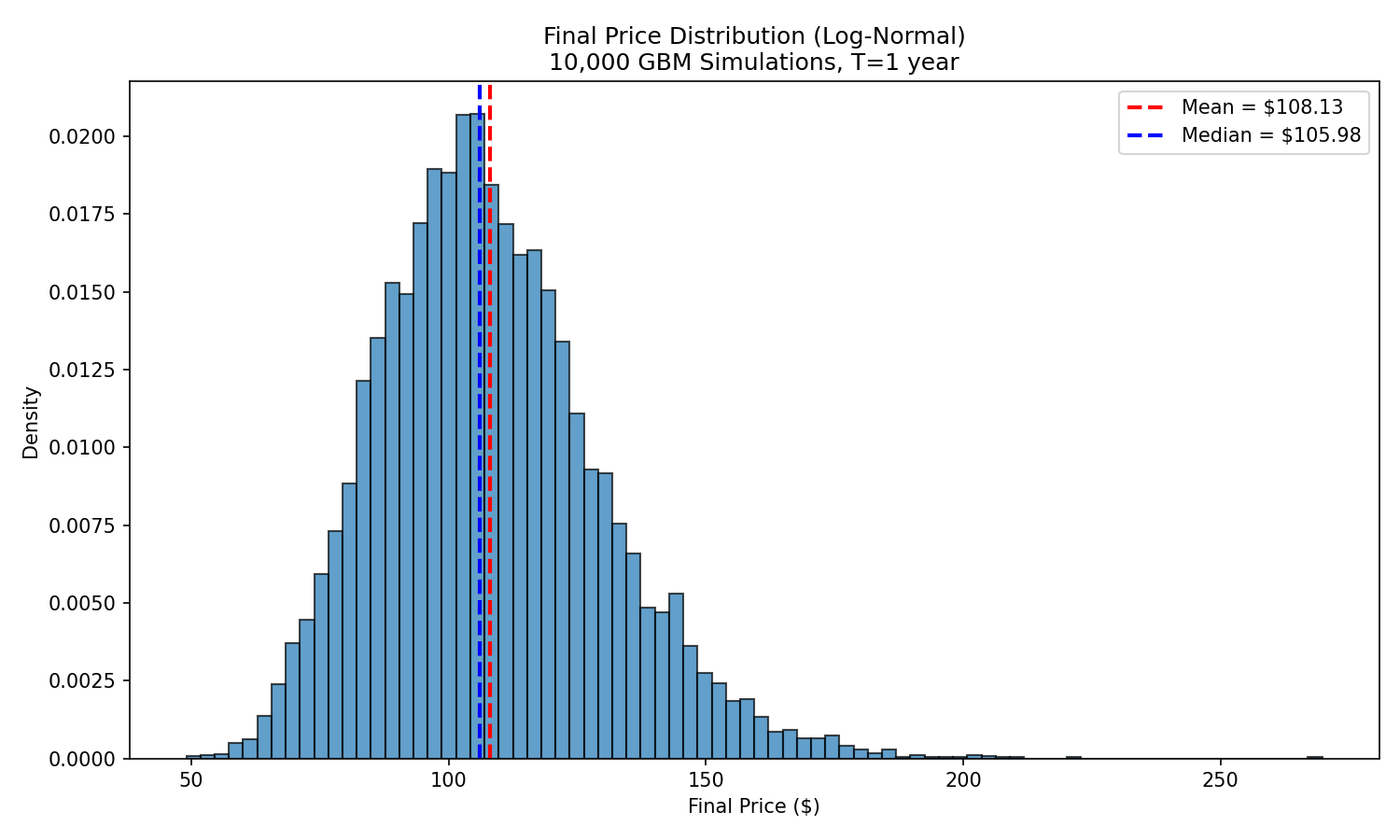
This distribution underlies:
- Black–Scholes
- geometric mean return
- exponential wealth dynamics
D. Strategy Return Bootstrapping
Let strategy returns follow some empirical distribution.
Simulate equity curves:
Repeating thousands of times reveals:
- expected drawdown
- 95% worst-case drawdown
- variability of Sharpe ratio
- likelihood of different future paths
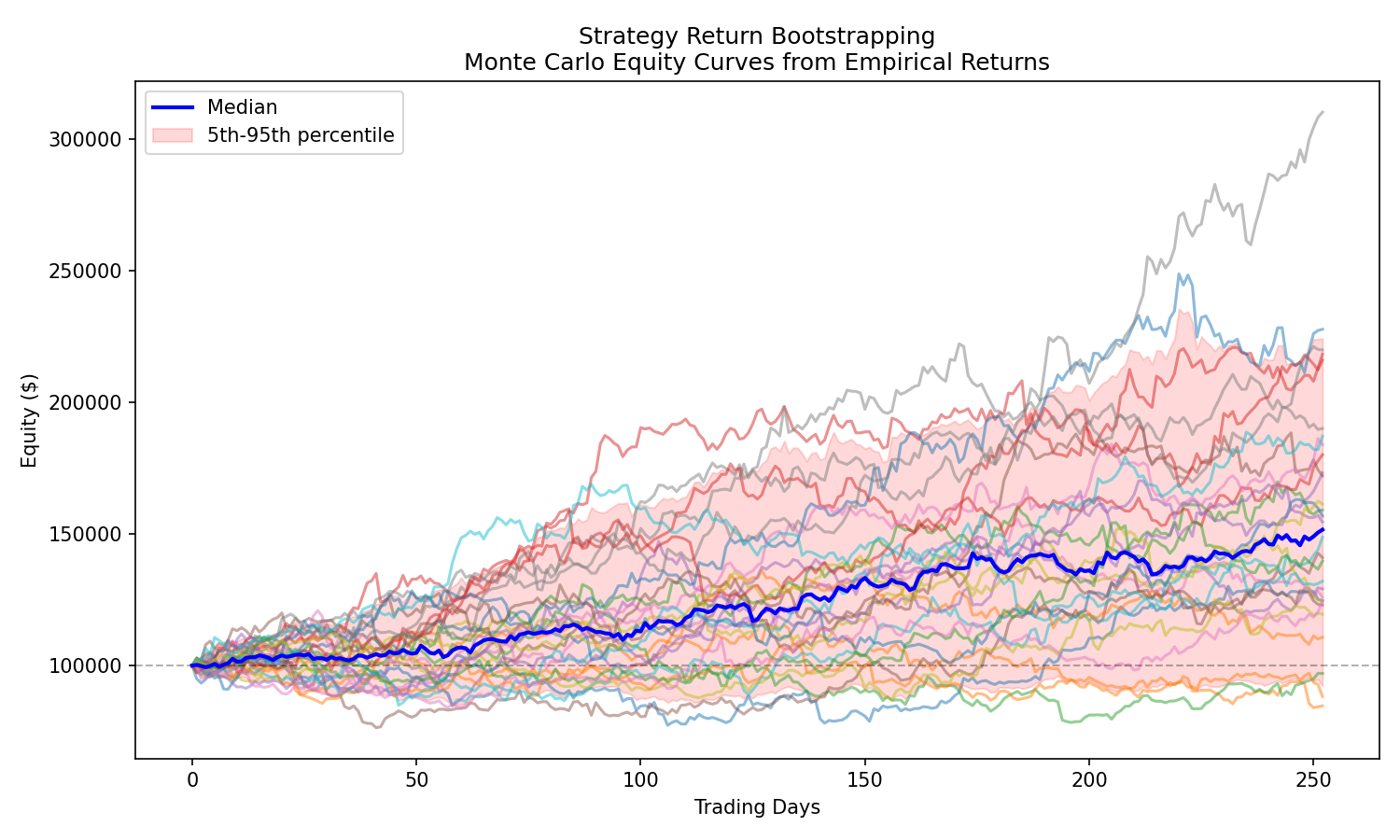
No single backtest can reveal this.
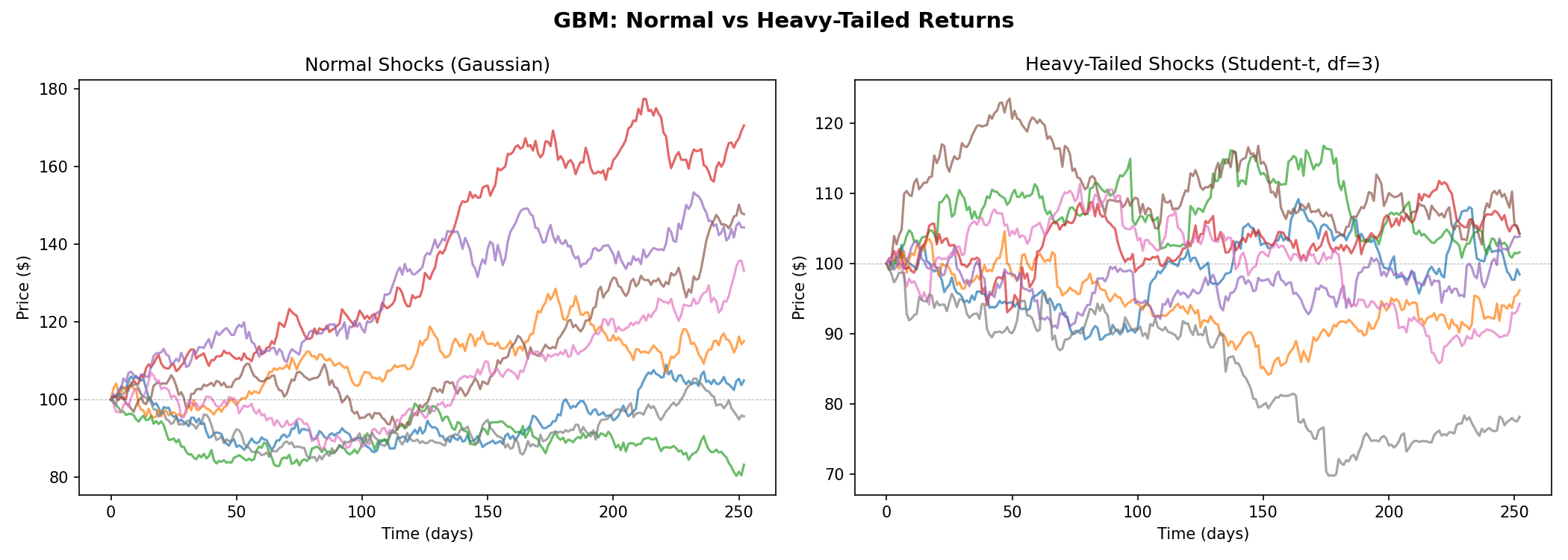
E. Heavy-Tailed Crash Scenarios
Replace normal shocks with Student-t shocks:
This introduces:
- more crashes
- fatter tails
- more ruin events
- more realistic crisis dynamics
F. Forecast Cones (Fan Charts)
Compute percentiles across paths:
- 5th percentile (worst case)
- median
- 95th percentile (optimistic)
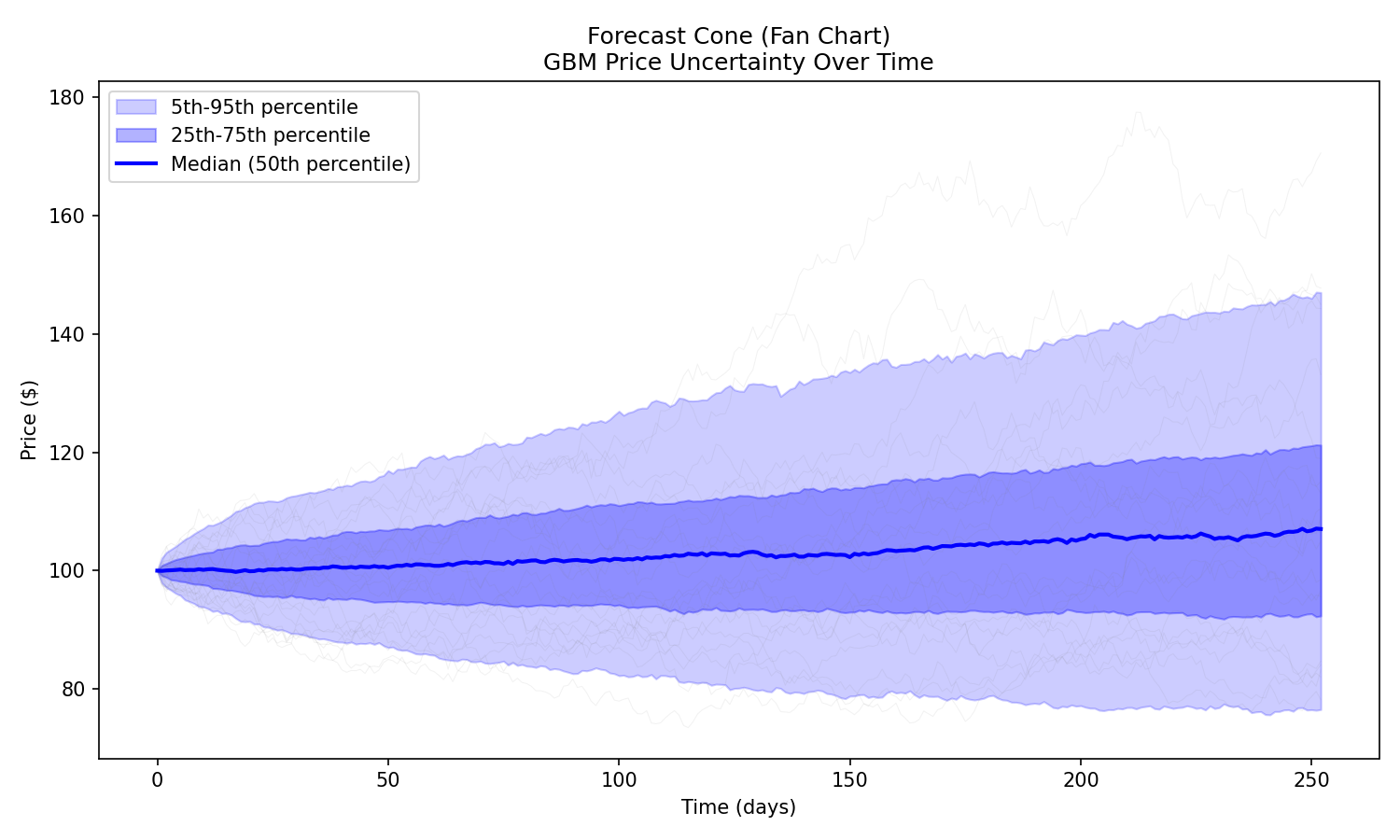
This creates the "uncertainty cone" used in:
- portfolio management
- risk reporting
- long-term forecasting
Why Monte Carlo Is Essential
Backtesting answers:
Does this system work on one historical path?
Monte Carlo answers:
Does this system survive thousands of plausible futures?
Monte Carlo exposes:
- hidden fragility
- left-tail danger
- sizing issues
- variance shock sensitivity
- survival probability
- robustness to noise
- drawdown uncertainty
Professional traders never deploy strategies without Monte Carlo analysis.
Key Takeaways
-
Random walks are the base model of unpredictability
-
Brownian motion is the continuous-time limit
-
GBM ensures positivity & multiplicative returns
-
Markets deviate from GBM but GBM is the essential baseline
-
Monte Carlo simulation is the only way to understand:
- drawdowns
- ruin
- performance variability
- tail risk
- robustness
Every trading strategy is not one equity curve. It is a distribution of equity curves.
Monte Carlo lets you see that distribution.